How to Stop Stressing About Money and Start Planning Every Dollar
Why the best budgeting method isn't about tracking what you spent — it's about deciding what every dollar does next.
Most budgets fail because they're rigid, backward-looking, and offer no way to recover when life happens. Zero-based budgeting fixes this by giving every dollar a job before you spend it — and letting you reallocate without guilt when plans change. The result isn't just better finances; it's less stress. This guide covers the psychology behind why it works, a step-by-step setup, and the common mistakes to avoid.
If you earn a decent income but still feel like your money disappears before the month ends, you're not imagining things — and you're far from alone.
Most Americans share this exact feeling. Nearly 7 in 10 say financial uncertainty has left them feeling depressed or anxious. Half worry about money every single day. And when asked what hurts their mental health the most, more people name money than politics, world events, or even their own physical health.
These aren't fringe findings. They come from three of the largest personal finance surveys in the country — Northwestern Mutual's 2025 Planning & Progress Study, Ramsey Solutions' Q4 2025 State of Personal Finance report, and Bankrate's 2025 Money and Mental Health Survey — each polling thousands of adults.
Here's what makes those numbers so frustrating: the problem isn't always about earning too little. It's about not having a clear plan for what you already have. When every dollar floats without a purpose, uncertainty fills the gap. And uncertainty is where financial stress takes root.
The good news? There's a method that directly attacks that uncertainty. It's called zero-based budgeting, and it works not because it's complicated but because it forces clarity. Every dollar gets a job before you spend it. The result isn't just a better budget — it's a quieter mind.
This guide will show you exactly how to build a zero-based plan, why planning forward reduces financial anxiety (backed by research you can actually use), and how to sidestep the mistakes that cause most budgets to fail.
Why Most Budgets Fail Before They Start
Before looking at the solution, it's worth understanding why so many people have tried budgeting and given up. If you've been there, none of this is your fault — the system was likely working against your psychology from the start.
The Diet Mentality
Traditional budgets operate like crash diets. You set strict limits, white-knuckle your way through two or three weeks, then one unexpected expense — a car repair, a friend's birthday, a medical copay — blows the whole thing up.
This isn't a willpower problem. It's a design problem. Research in the Journal of Consumer Psychology has shown that detailed budget tracking depletes the same mental resource we use for self-control. The tighter the constraints, the faster that resource drains — and when it's gone, spending discipline collapses.
This creates what psychologists call the "what-the-hell effect." You overspend by $40 on groceries, feel like you've already failed, and give yourself permission to stop trying altogether. One overspent category cascades into a full budget meltdown — not because you lack discipline, but because the system offered no way to recover gracefully.
The Tracking Trap
Most budgeting advice centers on one activity: track everything. Download an app, categorize every latte, review your spending at the end of the month. The problem is that tracking alone is exhausting — and backward-looking by design.
A 2020 Intuit survey of over 1,500 Americans found that more than 60% didn't even know how much they'd spent the previous month. That's not because those people are irresponsible. It's because manually categorizing every transaction across multiple accounts and credit cards is a second job most people don't have the bandwidth to sustain.
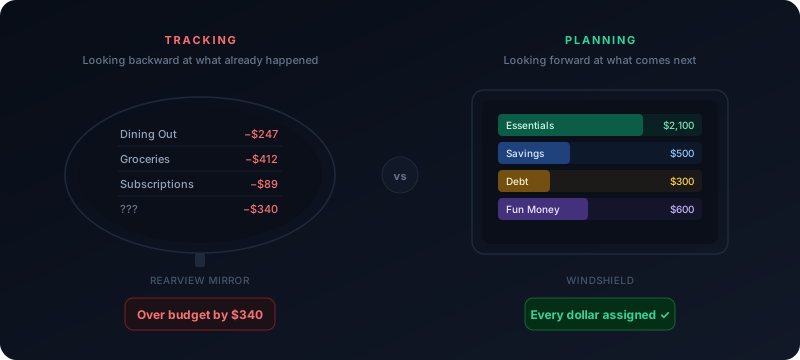
Worse, tracking-focused apps show you where your money went — past tense. It's like driving by staring only at the rearview mirror. By the time you see the problem, the money is already gone. You can't un-spend $200 on dining out just because an app tells you at month's end that you exceeded your limit.
The Rigidity Problem
Even well-designed budgets break when they can't bend. Holiday gifts, annual insurance premiums, a suddenly sick pet, a wedding you forgot about — life doesn't fit neatly into twelve identical monthly boxes.
As certified financial planner Catherine Hawley told NerdWallet: "I think one thing that can be problematic is that there are a lot of variable expenses. If you don't account for your irregular expenses, [a budget] is going to potentially not leave you with enough money on average."
Traditional budgets have no built-in mechanism for absorbing the unexpected. When an unplanned expense arrives — and it always does — the whole framework collapses. Not because the budget was wrong, but because it was brittle.
Why Planning — Not Just Tracking — Reduces Stress
Here's where most budgeting advice goes sideways. The answer to financial stress isn't more tracking — it's better planning. And that's not just a nice reframe. It's backed by decades of psychological research.
Uncertainty Is the Real Enemy
Most financial advice misses this: the amount of money in your bank account is not the primary source of financial stress. The primary source is ambiguity — not knowing whether you can absorb a surprise, not knowing what's already committed versus what's truly available, not knowing where last week's $400 actually went.
That ambiguity creates a low-grade anxiety that runs in the background of every spending decision. "Can I afford this?" becomes a question you can never quite answer, because your bank balance doesn't tell you what's already spoken for.
A forward-looking plan eliminates that ambiguity. When every dollar has a purpose assigned before you spend it, the question changes. Instead of "Can I afford this?" you ask "Is there money in this category?" — and the answer is always clear.
The Science of If-Then Plans
In 2006, psychologist Peter Gollwitzer at New York University published a sweeping meta-analysis of 94 studies involving over 8,000 participants. He was studying what he called "implementation intentions" — specific if-then plans that spell out exactly when, where, and how you'll act on a goal.
The results were consistent and significant: people who made concrete if-then plans were far more likely to follow through than those who simply set goals. This held across health behaviors, academic work, personal projects, and financial decisions. The takeaway was clear — vague intentions fail; specific plans succeed.
A zero-based budget is essentially an implementation intention for your money. Instead of vaguely hoping to "spend less" or "save more," you assign specific amounts to specific purposes: rent, groceries, emergency fund, debt payoff. When a dollar arrives, it already has instructions. No deliberation required — and that's precisely why it works.
Clarity Creates Confidence — and Confidence Compounds
The Northwestern Mutual study revealed something powerful: 76% of Americans who work with a financial advisor describe their finances as "strong," compared to just 44% of those without one. That's a 32-percentage-point gap in financial confidence.
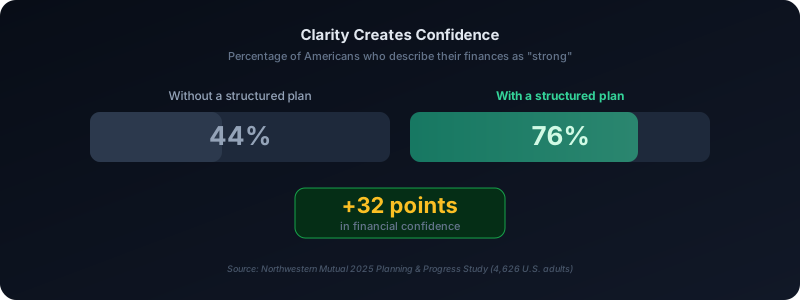
Why? Not because advisors necessarily generate more income for their clients. It's because having a structured plan — knowing where your money is and where it's going — fundamentally changes how you feel about your financial life. And feelings compound. When you feel in control, you invest instead of hoarding cash. You negotiate harder at work. You open your bank statements instead of avoiding them. Clarity replaces anxiety, and better decisions follow.
Professor Chuck Howard at the University of Virginia's Darden School of Business studies financial decision-making and has found that the way people predict their expenses directly shapes how they manage them. People who plan proactively — even imperfectly — consistently make better financial decisions than those who react to spending after the fact.
Planning isn't just about dollars. It's the foundation for building wealth.
Zero-Based Budgeting: The Method
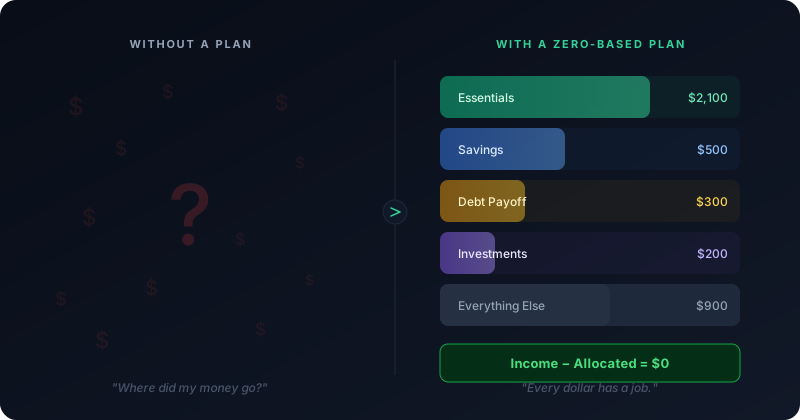
The concept is simple. Your income minus your planned expenses equals exactly zero. Every dollar you earn gets assigned a specific job — rent, groceries, savings, debt payoff, entertainment — until nothing is left unallocated.
The key word is planned. This isn't about spending every cent. It's about deciding in advance where every cent goes. If you earn $4,000 this month and allocate $500 to savings, $200 to investments, and $300 to extra debt payments, those are "expenses" in your zero-based plan. The remaining $3,000 covers everything else. The total: $4,000 in, $4,000 allocated. Zero remaining unassigned.
The method was popularized in personal finance by Dave Ramsey and built into tools like You Need A Budget (YNAB), but the core philosophy is older and simpler than any app: money without a purpose gets wasted. When dollars sit in your checking account with no assignment, they quietly disappear into impulse buys, forgotten subscriptions, and spending you can't quite account for. Zero-based budgeting closes that leak.
Think of it as a GPS for your money. You program the route before you drive — not analyze the trip after you've already ended up somewhere you didn't mean to be.
How to Create Your Zero-Based Plan (Step by Step)
Quick Start: Calculate your take-home pay. List every expense — including irregular ones. Sort them into three groups: Essentials, Financial Goals, and Everything Else. Assign every dollar until the total equals zero. When life throws you a curveball, move money between categories instead of abandoning the plan.
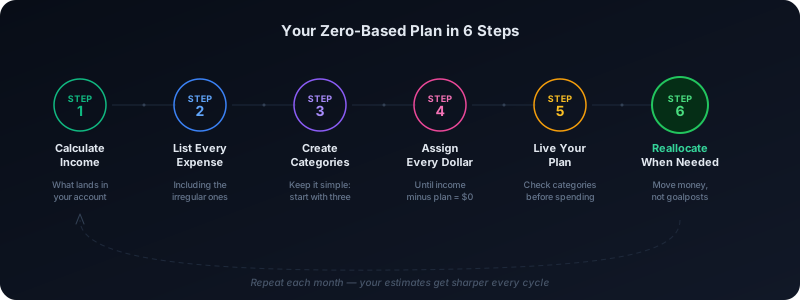
Step 1: Calculate Your Monthly Take-Home Income
Start with what actually lands in your bank account after taxes and deductions. Include your primary paycheck, any side income, freelance payments, child support, investment dividends — everything. If your income fluctuates, use the lowest amount from the past three months as your baseline. You can always allocate extra money when it arrives; you can't un-spend money you budgeted but didn't earn.
Step 2: List Every Expense You Can Think Of
Pull your bank and credit card statements from the last two to three months. Write down every recurring bill (rent, utilities, insurance, subscriptions), every variable expense (groceries, gas, dining out), and every irregular expense (annual memberships, car maintenance, gifts, medical copays).
The irregular expenses are what sink most budgets. People forget about them, and when they arrive, the whole plan collapses. Anticipate birthdays, holidays, insurance premiums, vet visits — anything that doesn't happen monthly but absolutely will happen.
Step 3: Create Your Categories — and Keep Them Simple
Here's a critical point most budgeting advice gets wrong: you don't need 47 categories. In fact, the more granular you go, the more likely you are to burn out.
If you're just starting, try this simplified approach: Essentials (housing, utilities, groceries, transportation, insurance, minimum debt payments), Financial Goals (extra debt payments, savings, investments), and Everything Else (dining, entertainment, clothing, personal spending). Three groups. That's it.
Add detail later as you get comfortable. The goal right now isn't to track every latte — it's to give every dollar a direction so you feel in control.
Step 4: Assign Every Dollar Until You Reach Zero
This is the heart of the method. Take your total income and begin allocating it across your categories, starting with essentials. Financial advisors often recommend covering the "Four Walls" first — food, shelter, utilities, and transportation — before anything else.
From there, fund your financial goals: emergency savings, extra debt payments, investments. Whatever remains goes to discretionary spending.
What if your expenses exceed your income? Something has to give — cut from the bottom of your priority list until the math works. And if income exceeds expenses, don't leave the surplus unassigned. Direct it toward savings, debt, or a specific goal. Every dollar gets a job.
Step 5: Live Your Plan (With Flexibility Built In)
Throughout the month, reference your plan before making spending decisions. The question isn't "Do I have money in my account?" — it's "Do I have money in this category?" One question is vague. The other has a definite answer.
Build in a "life happens" buffer — a small category specifically for unexpected minor expenses. This prevents one surprise from derailing the entire plan.
Step 6: Reallocate When Life Happens
This is the most important step, and it's the one that separates zero-based budgeting from every rigid budget you've tried before.
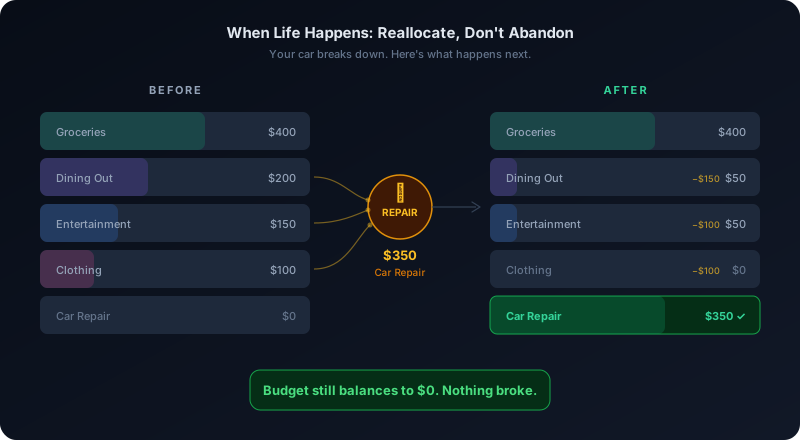
When you overspend in one category — and you will, because you're human — you don't throw the plan away. You move money from another category to cover it. Spent $50 more on groceries than planned? Pull $50 from dining out or clothing. Your car needed a repair? Move funds from entertainment and personal spending.
The budget still balances to zero. You just redistributed. Nothing broke. You're still in control.
This reallocation step is what transforms budgeting from a pass-or-fail test into a living document. Think of it like a flight plan. Pilots don't abandon the trip when they hit turbulence — they adjust altitude, reroute around a storm, and keep flying toward the destination. Your spending categories might shift mid-month. Your financial goals don't.
Real People, Real Results
The method sounds good in theory. But does it actually work in practice? Here's what the evidence — and real stories — say.
From $215,000 in Debt to Zero
Cindy Zuniga-Sanchez graduated from law school in 2015 carrying $215,000 in debt — 90% from law school, the rest from undergrad loans and credit cards. Her wake-up call came when she realized that $20,000 of her first year's $24,000 in payments had gone entirely to interest. Almost nothing touched the principal.
So she adopted zero-based budgeting and became deliberate about every dollar. In 48 months, she paid off the entire balance. "That type of budgeting method really allowed me to see exactly how much I was bringing in and exactly what I was doing with everything that went out," she told Good Morning America. She now runs a financial coaching business called Zero Based Budget.
Another couple, documented on the blog Living That Debt Free Life, paid off $68,000 in a single year using a zero-based budget and went on to eliminate $105,000 in total debt over three years.
These are extraordinary results, but the underlying principle is ordinary: when you tell every dollar where to go, you find money you didn't know you had.
Budgeting as a Stress-Relief Strategy
Budgeting as a stress-management tool is more popular than you might expect. In Motley Fool's 2024 Financial Stress Survey of 2,000 Americans, 53% named budgeting as their go-to way to cope with financial anxiety — ahead of picking up a side hustle, exercising, or meditating.
Common Pitfalls (and How to Avoid Them)
Don't confuse planning with tracking. The goal isn't to log every transaction with obsessive precision. It's to assign every dollar a purpose before you spend it and adjust as needed. Some months, you'll track closely. Other months, you'll check in weekly. Both are fine. The plan is what matters, not a perfect transaction history.
Don't forget irregular expenses. This was mentioned in Step 2, but it bears repeating: car registration, holiday gifts, dental visits, and annual subscriptions will arrive whether you plan for them or not. Divide their yearly cost by twelve and set aside that amount each month. When the bill comes, the money is already waiting.
Don't over-complicate your categories. If categorizing 30 different spending types sounds exhausting, collapse them. Essentials and non-essentials is a perfectly valid starting point. You can always refine later.
Give yourself three months. The first month will feel messy. You'll forget expenses, underestimate categories, and overspend somewhere. That's normal — it's calibration, not failure. By month two, your estimates sharpen. By month three, the system clicks.
Treat reallocation as a feature, not a failure. This is worth repeating. Moving money between categories isn't cheating. It's the entire point. Your budget is a plan, and plans adapt. The only failure is having no plan at all.
Start Planning Wiser
If zero-based budgeting makes sense to you but the idea of maintaining it with spreadsheets or generic apps feels like too much — that's the gap we built for.
Here's what it comes down to: you don't need to earn more money to feel in control of it. You need a plan that's easy to make, easy to adjust, and designed for how life actually works.
Planning Wiser is a personal finance app built around the principles in this guide. It's not another expense tracker that tells you where your money went last month. It's a planning tool that helps you decide where every dollar goes next.
You can plan multiple months ahead, set financial goals your dollars actively work toward, and customize your categories to fit your life — whether that's three broad buckets or twenty detailed ones.
When an unexpected expense hits, reallocation is one tap. Move money between categories without guilt, without breaking your plan, without starting over. Adjusting isn't failure. It's the whole point.
How it works in practice
Forward-looking by design. Set your plan before the month begins, then adjust as reality unfolds — not the other way around.
Reallocation built in. Overspent somewhere? Redistribute from another category. Your budget stays balanced. Your progress stays intact.
Goals you can see. Every dollar connects to something you care about — debt payoff, emergency savings, a vacation fund, retirement contributions. Watch the progress, not just the transactions.
Start simple, add detail later. Two categories or twenty — Planning Wiser adapts to wherever you are, because the best budget is the one you'll actually use.
Mobile-first. Check a category before you buy. Update your plan on the go. Stay in control without blocking out an evening for spreadsheets.
That's what Planning Wiser is for.
Try Planning Wiser for free at planningwiser.com
Sources
- Northwestern Mutual. "2025 Planning & Progress Study." Conducted by The Harris Poll among 4,626 U.S. adults, January 2–19, 2025. Published June 3, 2025.
- Ramsey Solutions. "The State of Personal Finance in America, Q4 2025." Nationally representative sample of 1,005 U.S. adults, fielded December 12–17, 2025.
- Bankrate. "Money and Mental Health Survey." Conducted by YouGov among 2,363 U.S. adults, March 19–21, 2025. Published April 2025.
- Motley Fool Money. "2024 Financial Stress, Anxiety, and Mental Health Survey." 2,000 American adults surveyed via Pollfish, March 6, 2024.
- Gollwitzer, P. M., & Sheeran, P. (2006). "Implementation Intentions and Goal Achievement: A Meta-Analysis of Effects and Processes." Advances in Experimental Social Psychology, 38, 69–119. Meta-analysis of 94 independent studies, 8,000+ participants.
- Gollwitzer, P. M. (1999). "Implementation Intentions: Strong Effects of Simple Plans." American Psychologist, 54(7), 493–503.
- Howard, R. C. "The Psychology of Money: Why We're Bad at Predicting Expenses and Income." Darden Ideas to Action, University of Virginia Darden School of Business.
- Vohs, K. D., & Faber, R. J. "Spent Resources: Self-Regulatory Resource Availability Affects Impulse Buying." Journal of Consumer Research, 33(4), 2007. Broader framework reported by MarketWatch and Yahoo Finance.
- Intuit (2020). Survey of 1,500+ Americans on spending awareness.
- Hawley, C. Quoted in NerdWallet, "Zero-Based Budgeting: What It Is And How It Works." November 2025.
- Zuniga-Sanchez, C. Interviewed by Good Morning America, "A zero-based budget helped this woman pay off $215K worth of student loan debt in 4 years." ABC News, March 6, 2020.
- Living That Debt Free Life. "A Detailed Guide to Making A Zero Based Budget." January 29, 2023.